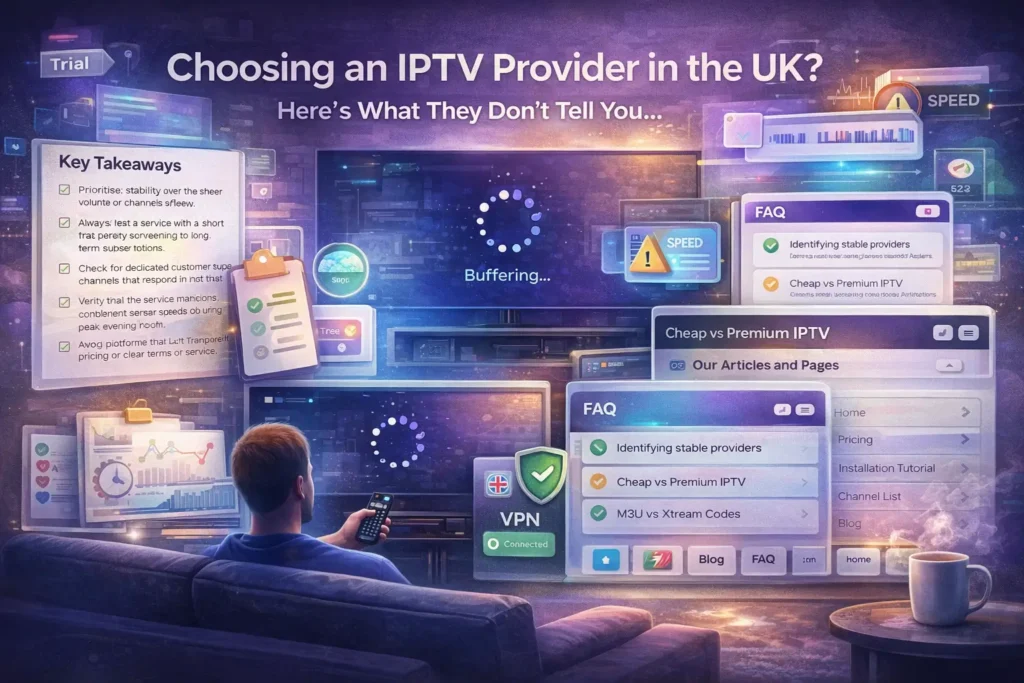
You never really understand internet protocol television providers until one of them disappoints you at the worst moment. Everything feels smooth at first… fast loading, clean interface, no issues. Then suddenly, a freeze. A delay. Or that moment where nothing loads at all.
That’s usually where people start questioning internet protocol television providers and what actually separates a solid one from the rest.
I’ve spent months going through different internet protocol television providers across the UK, and honestly, most of them look good only at the beginning. After a few days, the real performance starts showing.
If you’ve ever tried switching between multiple internet protocol television providers, you already know how confusing it gets. Too many options, too many promises, and not enough real results.
If you want to see how real services are presented and structured, you can take a look at the official homepage here before diving deeper.

This isn’t about hype. It’s about what actually works when you use it daily. And by the end, you’ll have a much clearer idea of which internet protocol television providers are worth your time… and which ones to avoid.
Everything Looks Good… Until It Doesn’t
After a while, you stop looking at what providers say… and you start looking at how they behave.
That’s the shift most people go through after trying a few internet protocol television providers. At first, everything sounds convincing. Big promises, smooth demos, attractive offers. But once you actually use different internet protocol television providers for a few days, patterns start to appear.
The small rules that save you from bad choices
Not complicated rules, just things that come from experience:
- Stability always beats channel quantity
- Short trials tell you more than long descriptions
- Real support matters more than fast replies at the start
- Peak hours reveal the truth about internet protocol television providers
- If pricing feels unclear, there’s usually a reason behind it
You’d be surprised how many internet protocol television providers fail on these simple points.
What really happens after day three
Here’s something almost nobody talks about openly.
Most internet protocol television providers perform well at the beginning. First day, maybe second… everything feels smooth. Then around day three, things start changing.
Channels take longer to load. Some streams become unstable. And suddenly, you’re not as confident as before.
This is where the difference between average and solid internet protocol television providers becomes obvious.
Signs you’re dealing with the wrong provider
You don’t need technical knowledge to spot it. Just pay attention:
- Random buffering during busy hours
- Quality dropping without reason
- Channels failing to open consistently
- Support that disappears after you subscribe
When you see more than one of these, chances are you’re not using one of the reliable internet protocol television providers.
Why testing properly changes everything
A quick test isn’t enough. That’s the mistake most people make.
If you’re serious about finding stable internet protocol television providers, test during peak hours. Evening time. High traffic. That’s when the real performance shows.
If it holds up there, you’re on the right track.
Cheap vs premium… where the gap becomes obvious
This part is simple, but people ignore it.
Before comparing, you can take a quick look at how pricing is structured → view current subscription options
| Type | First impression | After real use |
|---|---|---|
| Cheap IPTV | Looks good at first | Becomes unstable quickly |
| Premium IPTV | Smooth from day one | Stays consistent over time |
The difference is not subtle. It shows fast.
Most internet protocol television providers that feel reliable over time sit in that premium range. Not because of marketing… but because better infrastructure costs more.
Where people are actually getting stable results (UK & beyond)
Instead of guessing, here’s a clearer picture of providers people keep coming back to:
| Provider | Region | Experience |
|---|---|---|
| britishiptvsub.com | UK | Stable, consistent performance |
| bestsubscriptioniptv.com | UK | Strong servers, smooth playback |
| bestcanadaiptv.com | Canada | Reliable long-term usage |
| iptv-nearme.com | Canada | Balanced performance |
| meilleurabonnement-iptv.com | France | Good consistency |
| iptvchaine.com | France | Budget but stable |
These aren’t random names. They’re part of the group of internet protocol television providers that tend to hold up better after real usage.
The hidden cost nobody mentions
Cheap services don’t just cost less… they cost your time.
Switching providers. Testing again. Fixing issues. Starting over.
In the end, most people who try multiple internet protocol television providers end up choosing stability over price.
And that’s usually when things finally start working the way they expected from the beginning.
What’s happening behind the scenes (and why it matters)
Most people don’t think about infrastructure… until something breaks.
You open your app, click a channel, and expect it to work. Simple. But behind that, there’s a whole system running, and that’s exactly where internet protocol television providers start to separate from each other.
Some internet protocol television providers invest in strong servers that handle traffic smoothly, even when everyone is watching at the same time. Others… not so much.
When servers are weak, you feel it instantly
You don’t need technical knowledge to notice poor infrastructure.
- Streams take longer to load
- Quality drops randomly
- Channels stop working during peak hours
That’s not your device. That’s not always your internet. That’s the backbone of the service struggling.
Reliable internet protocol television providers don’t show these issues often, because their infrastructure is built to handle real usage, not just demos.
Cheap vs strong infrastructure (the real difference)
It’s not just about price, it’s about what’s behind it.
| Type | Server strength | Real experience |
|---|---|---|
| Budget IPTV | Weak / overloaded | Unstable during peak time |
| Premium IPTV | Optimised / balanced | Smooth and consistent |
Most internet protocol television providers that perform well long-term fall into the second category.
Support… you only notice it when you need it
Nobody thinks about support at the beginning. Until something stops working.
With weaker internet protocol television providers, support often disappears right after payment. Slow replies, no real solutions, or just silence.
Stronger providers usually respond faster and actually help solve the issue, whether it’s login problems or app-related setup.
If you want to see how setup usually works in real conditions, you can check this → simple installation steps explained
M3U vs Xtream… what actually feels better
This is where things get interesting.
M3U works. It’s simple, flexible, and supported almost everywhere. But after a while, you may notice small inconsistencies.
Xtream Codes feels more structured. Faster navigation, better organisation, and usually fewer issues when used with good internet protocol television providers.
Quick comparison (real usage, not theory)
| Format | Ease of use | Stability | Daily experience |
|---|---|---|---|
| M3U | Very easy | متوسط | Works, but not always consistent |
| Xtream Codes | Slight setup | High | Smoother and more reliable |
It’s not about what sounds better… it’s about what works when you actually use it every day.
Apps can change everything
Even with good internet protocol television providers, the app you use matters more than people think.
Some apps handle streams better. Faster loading, smoother playback, fewer crashes.
Others feel heavy, slow, or outdated.
That’s why when someone says they found the best internet protocol television providers, they’re often talking about a combination of server + app + device.
Small optimisations that actually help
Nothing complicated, just real things that improve your setup:
- Use Ethernet instead of Wi-Fi if possible
- Keep your apps updated
- Restart your device from time to time
- Don’t overload your device with background apps
These small changes can make a big difference, even with average internet protocol television providers.
At the end, performance is not just one thing. It’s everything working together. And once it’s right, you stop thinking about it… and just watch.

By understanding the technical aspects of IPTV and making informed choices about the service and device used, UK users can enjoy a smoother and more reliable viewing experience.
Navigating Peak-Hour Buffering and Connection Stability
The excitement of live sporting events can quickly turn to frustration when IPTV connections falter. For users in the UK relying on IPTV channels UK for their entertainment, a stable connection is crucial, especially during peak hours.
Peak-hour buffering and connection instability are common complaints among IPTV users. This issue is not just about the inconvenience; it can significantly impact the viewing experience, particularly for live events.
Why Performance Dips During Live Sporting Events
Live sporting events attract a large audience, and the surge in viewers can strain IPTV services. When thousands or even millions of users tune in simultaneously, the demand for bandwidth increases exponentially. If the IPTV provider’s infrastructure is not robust enough, this surge can lead to buffering and connection issues.
Reliable IPTV UK services invest in scalable infrastructure to handle such spikes in demand. However, not all providers are equipped to manage these loads effectively, resulting in a compromised viewing experience.

When it starts buffering… what’s really going on
It always happens at the worst time. You’re watching something important, everything is fine… then suddenly it freezes. You reload, it plays for a few seconds, then freezes again.
That’s usually when people start blaming everything at once, the app, the device, even the internet. But with internet protocol television providers, buffering rarely comes from just one reason.
Start with the obvious (but don’t assume too fast)
Before overthinking it, check the basics:
- Is your internet stable at that moment?
- Are other devices using bandwidth heavily?
- Does the same issue happen on all channels?
If everything is lagging, it might be your connection. If it’s random, it could be the provider itself. Even good internet protocol television providers can struggle if servers are overloaded.
The UK reality… peak hours change everything
Evening time is where things get serious.
Many internet protocol television providers perform well during the day, but once traffic increases, the difference becomes clear. Strong servers stay stable. Weak ones start dropping quality or freezing.
That’s why testing during peak hours matters more than anything else.
Quick fixes that actually work (no complicated tricks)
Sometimes the solution is simpler than people expect:
- Restart your router (yes, it still helps)
- Restart your IPTV app
- Close apps running in background
- Try another player before blaming the service
These small steps can stabilise your setup, especially when using decent internet protocol television providers.
Wi-Fi vs Ethernet… the difference is real
| Connection Type | What you feel |
|---|---|
| Weak Wi-Fi | Random buffering, unstable playback |
| Strong Wi-Fi | Acceptable, but not perfect |
| Ethernet | Stable, smooth, consistent |
If you’re serious about getting the best out of internet protocol television providers, a wired connection makes a noticeable difference.
ISP throttling… the hidden factor
In the UK, some internet providers slow down certain types of traffic during busy hours. That includes streaming.
That’s where a VPN can help. Not always necessary, but in some cases, it smooths things out by avoiding those restrictions.
If you’re exploring how setups work and how to improve them further, you can check this → complete IPTV setup guide
Not all VPNs are equal
Some slow things down even more. Others actually improve stability.
The key is using one that’s optimised for streaming, not just privacy. Otherwise, you might fix one problem and create another.
Final thought on buffering
Buffering is frustrating, but it’s also revealing.
It shows you the limits of your setup, your connection, and most importantly, your provider.
With strong internet protocol television providers, these issues stay rare. With weaker ones, they become part of the experience.
And once you notice that difference, you don’t really forget it.