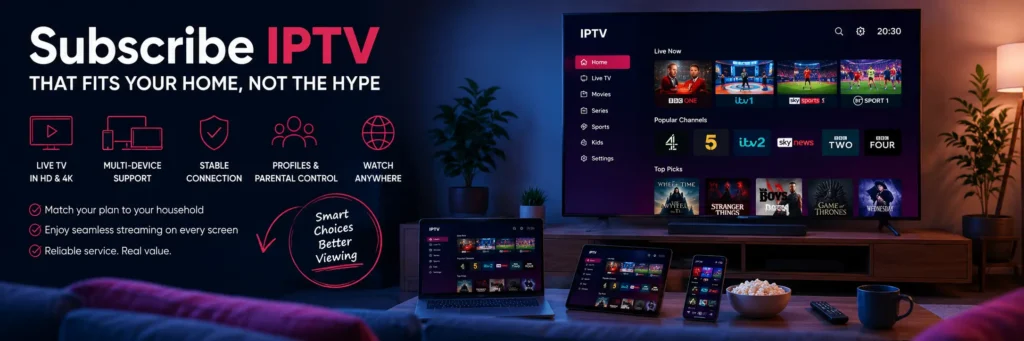
Subscribe IPTV Without Paying for More Than Your Home Needs
At 9 PM, the television is busy, someone wants to watch on a tablet, and another screen is already in use. This is where choosing the wrong TV setup becomes noticeable: you may be paying for several services while still fighting over what can be watched and where.
Before you subscribe iptv, start with your household rather than the biggest channel count. Think about the devices you actually use, how often two people watch at the same time, and which content matters enough to pay for.
A well-chosen Subscribe IPTV should fit naturally around those habits. Instead of collecting unnecessary packages, compare compatibility, connection limits and everyday usability. You can start by exploring the available UK IPTV subscription options and then judge whether the service genuinely matches the way your household watches TV.

This guide will show you what to check before you subscribe iptv, so you can make a more informed choice without paying for features your household will rarely use.
Build the Right Setup Before You Subscribe IPTV
The easiest way to overspend on television is to choose a package before thinking about how your home actually watches.
One person may use the living-room TV every evening. Another might only watch on a tablet at weekends. Someone else may want access while travelling. Those habits matter far more than the number of features printed on a sales page.
Before you subscribe iptv, I’d make three quick decisions.
1. Work out when your screens actually overlap
Count the screens people really use at the same time, not every device capable of running an app.
A household might own:
- one Smart TV in the lounge;
- a second television upstairs;
- two phones;
- a tablet;
- a streaming box.
That does not automatically mean six simultaneous connections are needed.
If the main TV is normally used in the evening and the tablet only comes out occasionally, one or two active connections may already cover the household comfortably.
This small check can stop you paying for capacity you never use.
2. Separate everyday viewing from “nice to have”
When people subscribe iptv, it is easy to be impressed by a huge package.
I would look at it differently.
Ask which categories are actually opened every week. Live sport might matter to one household, while another spends more time with films, series, documentaries or children’s content.
Then look at features.
Do you genuinely need several active screens? Will you use catch-up? Do you care about advanced favourites and EPG organisation? Is mobile access important when travelling?
A useful feature is one that saves you time every week. Everything else is just decoration.
3. Put a real number on your TV budget
This is where the decision becomes much easier.
Instead of asking, “Is this cheap?”, compare the cost with what you currently spend across different entertainment subscriptions.
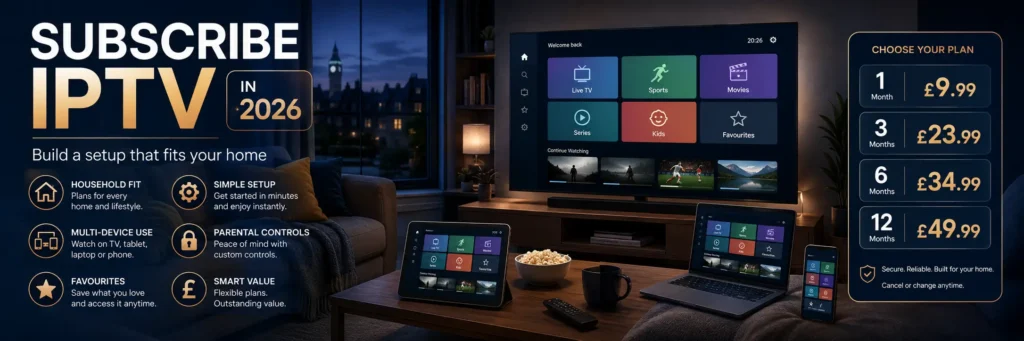
For a UK household, the available plans are:
- 1 month: £9.99
- 3 months: £23.99
- 6 months: £34.99
- 12 months: £49.99
You can compare the current IPTV plans and prices before deciding which duration fits your budget.
The one-month option makes sense if you want flexibility. Three or six months sit somewhere in the middle. The twelve-month option lowers the effective monthly cost for someone who already knows the setup works well for their household.
That is the part many buyers miss.
The cheapest-looking plan today is not automatically the best value, and the longest plan is not automatically the smartest choice either.
A simple way to choose without overthinking it
If you live alone, start by asking whether one screen covers almost everything.
For a couple, think about how often two different programmes are watched at the same time.
For a family, simultaneous use becomes more important than the number of devices in the house.
And if you travel frequently, portability may matter more than adding another television at home.
That gives you a much clearer reason to subscribe iptv than simply choosing the package with the biggest list.
The right setup should feel slightly boring once it is configured. Everyone knows where to watch, nobody is fighting over connections, and the monthly cost makes sense.
That is usually a better sign of value than any oversized feature list.

One Subscription, Four Very Different Homes
Two households can buy the same plan and get completely different value from it.
That is why I would never subscribe iptv based only on the number of devices listed on a sales page. The useful question is simpler: who actually watches, where do they watch, and how often do those viewing times collide?
Living alone? Keep the setup deliberately small
A single viewer rarely needs a complicated multi-screen arrangement.
If most evenings happen on one Smart TV, concentrate on making that screen work properly. Keep one dependable player, organise a short favourites list and avoid paying extra just because another plan supports more connections.
You can still configure a phone or tablet for occasional use. The key distinction is that owning three compatible devices does not necessarily mean you need three active streams.
For one person, convenience usually beats capacity.
For couples, the important hour is usually the same one
The problem for two people is rarely the number of screens in the flat.
It is 8 or 9 PM.
One person wants live sport in the lounge while the other would rather watch a film upstairs. If that happens regularly, two simultaneous connections suddenly become genuinely useful.
If it happens once every two months, paying for extra capacity all year makes much less sense.
Before you subscribe iptv, think about your busiest hour rather than your average day.
That one hour often tells you which plan you really need.
Family homes need rules more than endless features
With children, multiple rooms and different routines, organisation starts to matter.
A practical family setup might mean:
- keeping children’s categories separate and easy to reach;
- using parental controls where the chosen player supports them;
- creating a short favourites list for each main screen;
- deciding which devices are actually allowed to stream simultaneously;
- keeping account credentials away from shared or public devices.
This is where paying for the right connection allowance has real value.
Not because “more is better”, but because nobody wants the living-room stream stopping when someone starts watching upstairs.
If several people will share the account, read the service terms for household use before choosing a plan. It is much easier to understand connection limits before purchase than after the first clash between screens.
Travellers should think about movement, not more screens
Frequent travellers have almost the opposite problem.
At home, one television may be enough. What matters is whether the setup remains practical when the viewing device changes.
A phone in a hotel, a tablet while staying away for the weekend, or a laptop during a longer trip all create different requirements from a fixed living-room television.
Before you subscribe iptv, check whether your intended use fits the provider’s rules around devices, networks and simultaneous connections.
And remember that public or hotel Wi-Fi can behave very differently from your broadband at home. A poor connection while travelling does not automatically mean the subscription itself is at fault.
The quickest way to find your household type
Forget labels like “Basic”, “Premium” or “Ultimate” for a minute.
Use these four questions instead:
Does one person normally control the main screen?
You probably need simplicity more than extra connections.
Do two people regularly watch different things at the same time?
A second active stream may be worth paying for.
Are several rooms genuinely active during the same evening?
Connection limits become one of your main buying criteria.
Does your main device change because you travel frequently?
Compatibility and portability matter more than a huge home setup.
Once you answer those honestly, choosing when to subscribe iptv becomes far less about marketing and much more about fitting television around the way your home already works.
That is usually where the best value is hiding.

The Cheapest-Looking Plan Is Not Always the Best Buy
Price gets attention first. Fair enough.
But before you subscribe iptv, the more useful question is not “Which plan costs the least today?” It is “Which plan makes sense if I am still happy with it three months from now?”
A short subscription gives you room to change your mind. A longer one normally makes more sense once the service already fits your home, your devices and your routine.
That difference matters more than people think.
Start short if anything still feels uncertain
If you are still figuring out which television will be used most, whether one connection is enough, or which player feels best, there is nothing wrong with starting smaller.
A monthly or short-term plan gives you time to see what daily use actually feels like.
By contrast, if you already know the service works well across the household, a longer period can offer better overall value.
The key is not automatically choosing the longest option when you subscribe iptv. It is choosing the point where confidence and price make sense together.
Look beyond the headline price
Before paying, I would check five things:
- how many simultaneous streams the plan actually allows;
- whether the account can be used on the devices you own;
- what happens when the subscription ends;
- whether renewal is automatic or manual;
- how support handles account or activation problems.
Those details are easy to ignore when a plan looks cheap.
They are much harder to ignore when someone upstairs opens a second stream and the living-room TV suddenly stops.
Treat renewal dates like any other household bill
A television subscription should not become something you forget about until money disappears from your account.
Save the renewal date somewhere simple.
Know how cancellation works.
Check whether the price stays the same when you renew.
And if you change plans later, understand what happens to the time already remaining on the account.
People often focus on the first payment when they subscribe iptv, but the second payment tells you just as much about whether the service is straightforward to manage.
Get the First Screen Working Before Setting Up the Whole House
This is where I would slow down.
Once your account is active, do not immediately configure five devices because they are sitting nearby.
Start with the screen that matters most.
For most homes, that is the television in the lounge.
One device first, everything else later
Add the account to your preferred player and make sure four basic things work:
The login is accepted.
No repeated errors or confusing activation steps.
The interface loads properly.
Categories, favourites and programme information should appear as expected.
Playback starts normally.
You should not need to restart the app every time you open something.
The remote feels natural.
If ordinary navigation feels annoying on day one, it probably will not become more enjoyable six months later.
Once that screen is working, move to the second device.
This approach makes troubleshooting much easier because you always know which change introduced a problem.
If this is your first setup, the British IPTV installation tutorial walks through the basic activation process without overcomplicating it.
Pick the player around the screen, not the other way round
Different devices benefit from different interfaces.
On Apple TV, apps such as IPTVX or UHF may appeal to users who prefer a polished remote-controlled layout.
On Android-based televisions or boxes, OTT Navigator or Sparkle TV can suit people who want more control over categories and programme information.
For phones and tablets, a lighter interface often makes more sense than a player designed mainly for a ten-foot television screen.
There is no prize for using the same app everywhere.
The better approach is to subscribe iptv once, then make each device as easy to use as possible.
Do not share credentials more than necessary
Your login details should stay within the devices and people covered by your plan.
Avoid posting screenshots containing account information, entering credentials into random players from unknown sources or sending login details to people outside the household.
It is a small habit, but it prevents a surprisingly large number of account problems.
The Subscribe IPTV setup should get simpler after day one
That is probably the best sign you chose well.
The first evening may involve installing an app, arranging favourites and getting everyone familiar with the remote.
After that, the technology should fade into the background.
If you subscribe iptv and still find yourself explaining the setup every night a month later, the package or player is probably more complicated than your household needs.
Good value is not just paying less.
It is paying for something that quickly becomes easy to live with.
Make the Setup Feel Like Your Home, Not a Control Panel of Subscribe IPTV
The technical work is finished once everything loads correctly. The part that determines whether people actually enjoy using it comes afterwards.
A household does not need hundreds of shortcuts on screen. It needs the right things to be easy to reach.
Before you subscribe iptv, think about who will hold the remote most often. A setup that feels obvious to you may still be frustrating for a child, an older relative or someone who simply does not want to learn a complicated television interface.
Build a home screen people can understand in seconds
Start by trimming the clutter.
Keep the categories your household actually uses and move frequently watched content into favourites. If the player supports separate favourites or profiles, use them to stop everyone’s preferences becoming one enormous list.
A family setup might look something like this:
- Main TV: shared favourites for everyday viewing
- Children’s screen: limited categories with parental controls
- Bedroom TV: a smaller list focused on regular evening viewing
- Tablet: lightweight setup for occasional or portable use
- Travel device: only the categories you actually need away from home
This may sound almost too simple, but that is the point.
After you subscribe iptv, finding something to watch should take less time, not more.
Parental controls deserve five minutes of attention
If children use the service, do not leave every category sitting openly in the same menu.
Many compatible players provide PIN protection, category locking or similar controls. The exact options depend on the app, so configure them directly on the devices younger viewers use.
The aim is not to turn the television into a security project. It is simply to avoid situations where a child can wander into content that was never intended for them.
Keep the PIN somewhere adults can remember it without writing it beside the television.
Favourites are more useful than a giant catalogue
There is a funny thing that happens with large content libraries.
At first, having endless choice sounds brilliant. A month later, most people return to the same small collection of favourites.
Use that behaviour to your advantage.
Create a short list for sport, another for films or series if your player allows it, and remove or hide categories nobody in the house touches.
The less time people spend scrolling, the more polished the entire subscription feels.
That matters when you subscribe iptv for everyday use rather than simply trying it for a weekend.
Before Calling Subscribe IPTV the Setup Finished
Once everyone has used the service for a few days, ask a few practical questions.
Can the least technical person in the house find what they want without help?
Do simultaneous streams behave according to the plan you purchased?
Are favourites still organised?
Does the main television open quickly without repeated setup?
Can you move to a phone or tablet when needed without turning it into a troubleshooting session?
If the answer is yes across the board, there is very little left to optimise.
And if something is unclear about connections, account use or activation, use the customer support page rather than guessing and changing random settings.
FAQ: The Questions That Usually Come Up After Setup your Subscribe IPTV
How many connections does my Subscribe IPTV really need?
Count simultaneous viewers, not devices.
Owning two televisions, three phones and a tablet does not mean you need six active streams. If only two people regularly watch different things at the same time, two connections may cover the household comfortably.
Check the rules of the specific plan before purchase.
Should I use the same Subscribe IPTV app on every device?
A television benefits from an interface designed around a remote control. A phone needs something comfortable with touch. What works beautifully on Apple TV may feel completely different on an Android-based television.
Apps such as IPTVX, UHF, OTT Navigator and Sparkle TV take different approaches, so choose according to the screen rather than forcing one player everywhere.
Is an annual Subscribe IPTV always better value?
Mathematically, a longer plan can reduce the effective monthly cost.
Practically, that only matters if you already know you are happy with the service.
If the setup is new to your household, starting shorter gives you more flexibility. Once everything works exactly how you want it, a longer duration can become the more economical choice.
Can I use my Subscribe IPTV while travelling?
That depends on the provider’s account and connection rules.
If travel matters to you, check this before purchasing rather than assuming that an account configured at home will automatically behave the same way on every network.
Also remember that hotel, public and mobile connections can be far less consistent than your broadband at home.
What should I do if one device works and another does not?
That difference is useful information.
Check whether the problematic device is running an up-to-date app and operating system. If possible, try another compatible player on the same device.
If the account works normally elsewhere, the device or software is more likely to deserve attention than the subscription itself.
How should I keep my Subscribe IPTV account information safe?
Treat login details like any other private account credentials.
Do not post screenshots containing usernames or server information publicly. Avoid entering your details into unknown apps, and do not share the account beyond what the subscription rules permit.
What should I check immediately before I subscribe IPTV?
Keep it simple.
Confirm the plan duration, simultaneous connection allowance, device compatibility, renewal terms and support options.
If those five things match the way your household actually watches television, you are making the decision for the right reasons rather than being pulled in by a feature list.
The Best Subscribe IPTV Setup Is the One Nobody Talks About
That sounds strange, but it makes sense.
When television is set up well, nobody in the house discusses the player, server format or account configuration. They pick up the remote and watch.
That is the standard I would use.
The goal is not to build the most impressive technical arrangement possible. It is to create something affordable, organised and simple enough that everyone can use it without thinking.
If your household reaches that point after you subscribe iptv, the subscription is doing exactly what it should.
Copyright and lawful-use notice
Subscribe IPTV is a technology used to deliver television and video over internet networks. Users should choose services and content that are distributed with the appropriate permissions and licensing rights.
This website does not claim ownership of third-party copyrighted material and does not encourage unauthorised access to, reproduction of or redistribution of protected content. Legitimate rights-holder enquiries may be submitted to the website operator for review.