When TV Quality Finally Feels Different
Most people don’t start searching for 8K IPTV because of technology. It usually begins with a simple frustration, blurry streams, weak picture quality, or sports that look fine until the action speeds up.
That’s where 8K IPTV starts to stand out. The image feels sharper, motion looks smoother, and modern TVs finally show the level of detail they were built for. Instead of relying on old cable or satellite systems, everything runs through your internet connection, which makes streaming more flexible and easier to manage at home.
For readers who want to explore the platform behind this streaming approach, you can see how the service is presented directly on the official IPTV homepage, where the overall setup and streaming environment are explained.

As more households upgrade their screens and internet speeds, 8K IPTV is slowly becoming the option people look at when regular television simply stops feeling impressive anymore.
Why More Viewers Are Quietly Switching to 8K IPTV
Something interesting is happening in home streaming. People who upgrade their screens quickly realise that regular television simply doesn’t keep up anymore. Modern TVs are capable of incredible detail, yet most traditional broadcasts still deliver compressed images that waste the potential of the display.
That gap is exactly where 8K IPTV starts making sense.
Instead of relying on outdated broadcast systems, 8K IPTV streams video through modern internet infrastructure. The result is a viewing experience that feels smoother, sharper, and far more responsive on large screens.
Here’s what usually convinces people to move toward 8K IPTV once they try it:
• Sharper picture depth
Scenes look more natural because the resolution captures finer visual details, especially noticeable on large smart TVs.
• Better motion stability
Fast scenes like sports or action sequences remain smooth without the blur often seen on traditional broadcasts.
• Flexible viewing freedom
You’re not tied to fixed schedules anymore. Content loads instantly across different devices.
• Cleaner streaming infrastructure
Since everything runs through broadband instead of satellite hardware, the system becomes easier to manage at home.
For readers curious about how subscription options are structured for this type of service, the overview of available plans on the IPTV pricing page gives a clearer idea of how modern streaming packages are organised.
As internet speeds continue improving across many regions, 8K IPTV is gradually becoming the logical step forward for households that want their television experience to match the quality of their modern displays.
What Makes 8K IPTV a Different Kind of Streaming Experience
When people compare traditional television with 8K IPTV, the difference isn’t only about sharper visuals. The real change is how the content actually reaches your screen.
Traditional broadcasting systems rely on fixed signals, cable networks, or satellite infrastructure. The signal travels the same way for every viewer. 8K IPTV, on the other hand, sends video directly through internet protocols. That means the stream adapts to your device, your connection, and your viewing habits.
Once viewers switch to 8K IPTV, a few improvements become obvious almost immediately:
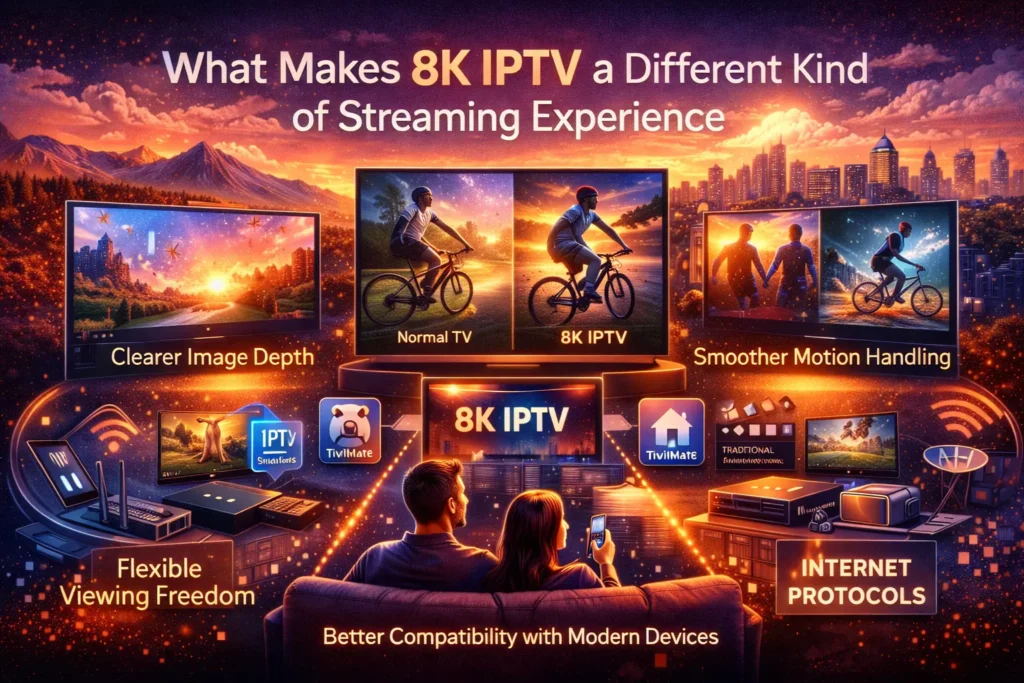
• Clearer image depth
The level of detail is noticeably higher, especially on larger smart TVs where standard broadcasts often appear compressed.
• Smoother motion handling
Fast scenes remain stable without the motion blur that sometimes appears in older broadcasting systems.
• Flexible viewing freedom
Content streams directly through your broadband connection, allowing multiple devices and easier control over what you watch.
• Better compatibility with modern devices
Streaming apps like IPTV Smarters, TiviMate, XCIPTV, or SmartOne IPTV can handle 8K IPTV streams smoothly when the connection is strong enough.
For readers comparing subscription options and streaming setups, the breakdown on the IPTV pricing plans gives a simple overview of how modern IPTV packages are usually structured.
To understand the visual difference more clearly, this quick comparison helps explain why many viewers consider 8K IPTV the next step in home entertainment.
| Feature | 8K IPTV Streaming | Traditional TV Broadcast |
|---|---|---|
| Resolution capability | Ultra-high resolution streaming | Limited broadcast quality |
| Delivery method | Internet protocol streaming | Cable or satellite signal |
| Device flexibility | Smart TVs, streaming devices, IPTV apps | Usually fixed to one box |
| Viewing control | On-demand and multi-device access | Schedule-based channels |
For households investing in large displays and fast fibre connections, 8K IPTV is increasingly seen as the logical upgrade from traditional television systems.

What Your Setup Actually Needs to Run 8K IPTV Smoothly
People often assume that upgrading to 8K IPTV is complicated. In reality, most homes already have part of what’s needed. The difference usually comes down to internet stability and the small pieces of equipment that keep the stream smooth.
Because 8K IPTV pushes far more visual data than normal streaming, your connection has to handle that extra load without interruptions.
Here are the few things that make the biggest difference in real-world streaming.
Internet speed matters more than anything
For ultra-high resolution streaming, the connection needs enough bandwidth to deliver large video files continuously.
• Around 100 Mbps is the minimum many setups can handle
• 150 Mbps or higher usually delivers a much smoother experience
• Fibre connections tend to perform better than older copper networks
If multiple people are streaming at the same time, the higher speed becomes even more important for stable 8K IPTV playback.
Connection type can change everything
Even with fast internet, the way your device connects to the router can impact performance.
| Connection Type | Typical Performance | Stability for 8K Streaming |
|---|---|---|
| Ethernet cable | Very fast | Excellent |
| Wi-Fi 6 | Fast | Good in most homes |
| Standard Wi-Fi | Moderate | Can fluctuate |
Whenever possible, a wired Ethernet connection tends to keep 8K IPTV streams stable, especially during high-motion scenes.
Network equipment also plays a role
A modern router capable of handling heavy traffic helps avoid buffering. Many households upgrading their streaming setup now use routers that support Wi-Fi 6, along with stronger Ethernet cables designed for high-speed data transfer.
Streaming apps like IPTV Smarters, TiviMate, XCIPTV, or SmartOne IPTV usually run smoothly once the connection and router are configured properly.
If you want a deeper explanation of how IPTV streams are structured behind the scenes, this technical breakdown of IPTV streaming systems and formats explains how modern IPTV delivery works in more detail.

Devices That Actually Handle 8K IPTV Without Struggling
A lot of people assume the hardest part of switching to 8K IPTV is the service itself. In reality, the device you watch on plays an even bigger role. If the hardware can’t process ultra-high resolution streams properly, even the best connection will feel slow.
The good news is that most modern streaming setups already support 8K IPTV, especially if you’re using a recent smart TV or a strong Android streaming box.
Let’s break down the devices that usually handle 8K IPTV the best.
Smart TVs Built for Ultra-HD Streaming
Large smart televisions are the easiest way to enjoy 8K IPTV because everything runs directly through the TV’s internal streaming system. Once the IPTV app is installed, the screen can display the full resolution without needing extra hardware.
Many households upgrading their living room setup choose large-screen smart TVs because they make 8K IPTV look dramatically sharper, especially in sports scenes or cinematic content.
Android Streaming Boxes That Boost Performance
Not everyone wants to replace their television immediately. That’s where Android streaming devices become useful. These small boxes connect through HDMI and upgrade an existing TV so it can handle modern IPTV streams.
Popular options often used for 8K IPTV setups include:
• NVIDIA Shield TV Pro – powerful processor and smooth playback
• Formuler Z-series devices – widely used in IPTV environments
• MAG IPTV boxes – designed specifically for IPTV streaming
These devices are particularly helpful when running heavier streaming apps or large playlists.
IPTV Apps That Handle 8K Streams Smoothly
Even with the right device, the IPTV application matters. Some apps simply handle large streams better than others.
The players most commonly used with 8K IPTV setups include:
• TiviMate – clean interface and strong performance
• IPTV Smarters – widely compatible with many IPTV services
• XCIPTV – lightweight and reliable on many Android devices
• SmartOne IPTV – simple setup and stable playback
When these apps run on capable hardware, 8K IPTV streams usually stay stable without the buffering issues people remember from older streaming platforms.
| Device Type | Why It Works Well for IPTV | Typical Use Case |
|---|---|---|
| Smart TVs | Built-in streaming hardware | Living room viewing |
| Android TV Boxes | Strong processors for IPTV apps | Upgrading older TVs |
| Streaming Sticks | Portable and easy setup | Secondary rooms |
For readers interested in learning how IPTV apps are installed on streaming devices, this step-by-step explanation of setting up IPTV on streaming devices shows how most people configure their viewing setup at home.
Where People Usually Find Reliable 8K IPTV Providers
Once someone decides to move toward 8K IPTV, the next question appears almost immediately. Which service should you actually trust?
The truth is that not every provider can deliver stable 8K IPTV streams. Resolution alone doesn’t mean much if the servers can’t keep up during peak hours. That’s why experienced users usually focus on a few key indicators before choosing a service.
Here are the things most viewers quietly check first when comparing 8K IPTV providers.
Server stability matters more than marketing
A strong IPTV service relies on powerful servers capable of handling thousands of connections at the same time. Without that infrastructure, streams can buffer or drop during busy hours.
Reliable 8K IPTV platforms typically maintain multiple servers to keep playback smooth and reduce interruptions.
Content variety should feel balanced
Instead of focusing on one category, strong IPTV services usually offer a broad mix of entertainment options. This keeps the platform useful for different members of the household.
A well-structured service normally includes:
• sports content
• movies and series
• general entertainment
• international programming
• family and kids content
Subscription structure should stay simple
Overly complicated subscription models are usually a red flag. The best 8K IPTV services tend to keep their pricing transparent and easy to understand.
Below is a quick comparison of several well-known IPTV platforms that people often explore when looking for modern streaming solutions.
| IPTV Platform | Main Focus | Typical Strength |
|---|---|---|
| britishiptvsub.com | UK-focused streaming services | Stable server performance |
| bestsubscriptioniptv.com | International IPTV packages | Wide device compatibility |
| iptv-nearme.com | Regional IPTV discovery platform | Flexible streaming options |
If you want a deeper look at how IPTV services are evolving in the UK streaming market, this detailed guide about modern IPTV services in the United Kingdom explains how different platforms structure their streaming infrastructure.
For many households upgrading their viewing setup, choosing the right 8K IPTV provider is less about hype and more about consistency. Stable servers, reliable streams, and balanced content usually matter far more than flashy marketing promises.
Where Ultra-HD Streaming Is Headed Next
If you follow how home entertainment evolves, one thing becomes obvious. Screens are getting bigger, internet speeds keep improving, and viewers expect sharper visuals every year.
That’s exactly why many analysts believe 8K IPTV will gradually move from a niche setup to something far more common in modern homes.
Several trends are quietly pushing the technology forward.
Display technology keeps improving
Television manufacturers are releasing larger screens every year, and newer panels are designed specifically for ultra-high resolution playback. As display technology improves, large screens start showing details that older broadcast systems simply cannot deliver properly.
Internet infrastructure is catching up
Streaming ultra-high resolution video requires strong broadband connections. Over the past few years, fibre networks have expanded rapidly in many regions. Faster internet makes advanced streaming platforms easier to run in everyday households.
More ultra-HD content is being produced
Production studios and streaming platforms continue experimenting with higher-resolution cameras and workflows. As more ultra-HD material becomes available, demand for high-resolution streaming platforms naturally grows.
If you want a deeper look at how streaming services are evolving across the UK market, this analysis of modern IPTV trends in the UK explains where the technology appears to be heading.
For many viewers upgrading their living-room setup today, ultra-HD streaming is no longer about novelty. It is slowly becoming the new expectation for home entertainment.
Final Thoughts
Streaming technology has moved incredibly fast over the past decade. What used to feel impressive in traditional broadcasting now looks limited compared with modern internet-based systems.
Ultra-high resolution streaming gives viewers far more control over how they watch television, what devices they use, and how flexible their setup becomes at home. When the right hardware, internet connection, and streaming platform come together, the difference in viewing quality becomes obvious.
For households investing in larger smart TVs and faster internet connections, this type of streaming setup is increasingly becoming the logical upgrade from traditional television systems.
Frequently Asked Questions
What does ultra-HD IPTV streaming actually mean?
Ultra-HD IPTV streaming refers to television delivered through internet protocols instead of cable or satellite infrastructure. Content is transmitted through broadband connections, allowing higher resolution and more flexible viewing options across multiple devices.
How fast should my internet be for high-resolution streaming?
A stable fibre connection usually provides the best experience. Many households aim for download speeds above 100 Mbps when running ultra-high resolution streams, especially if multiple devices are connected to the network.
Do I need a special TV for ultra-HD IPTV?
Large smart TVs designed for high-resolution playback tend to provide the best results. However, many viewers also use Android streaming devices connected through HDMI to upgrade their existing television.
Which IPTV apps are commonly used for streaming?
Several applications are widely used for IPTV playback, including TiviMate, IPTV Smarters, XCIPTV, and SmartOne IPTV. These apps are designed to handle large playlists and stable streaming connections.
Is IPTV difficult to install?
Most IPTV setups are relatively simple. In many cases, users only need to install an IPTV player on their device and load their playlist or login credentials. After that, the content becomes accessible directly through the application interface.
DMCA Disclaimer
This website provides information about IPTV technology and streaming services for educational purposes only. We do not host, operate, or distribute any television channels, media streams, or copyrighted material. Any external services mentioned are the responsibility of their respective providers. Users are solely responsible for ensuring that their use of IPTV services complies with the laws and regulations applicable in their country.